The Weight of Silver: Measurements, Money, and the Mechanics of Nanban Commerce
A reference guide to the weights, distances, volumes, and currencies that made the Portuguese-Japanese trade possible, and profitable.
Why Measurements Mattered
Most articles on this site tell stories about people: missionaries who crossed oceans, warlords who burned churches, diplomats who lost their heads. This one is about numbers. Specifically, it is about the numbers that every merchant, factor, Jesuit procurator, and customs official in the Nanban trade had to carry in their heads, or on scraps of paper, or inscribed on the brass weights they kept in leather pouches, in order to do business across three incompatible systems of measurement.
The Portuguese-Japanese trade (1543–1639) connected economies that measured the world in fundamentally different ways. Japan ran on rice. Its political economy was denominated in the koku, a volumetric unit tied to agricultural output, and its commercial transactions in the international ports were conducted by physically weighing silver on balance scales, gram by gram. Portugal ran on a mix of physical coins and “imaginary money”, units of account like the cruzado that referred to coins that no longer existed, settled in practice by weighing out equivalent quantities of bullion. China, the indispensable third party in the triangle, ran on a silver-by-weight standard that shared vocabulary with the Japanese system (taels, catties, piculs) but not always the same definitions.
The result was an environment in which a Portuguese factor arriving in Nagasaki with a hold full of Chinese silk had to perform a cascade of conversions, Macau piculs to Japanese piculs, Chinese taels to Japanese momme, cruzados-as-accounting-units to physical grams of silver adjusted for metallurgical purity, before he could determine whether his voyage had been profitable. Getting the conversions right was not merely advantageous. It was the entire business model.
The sections that follow lay out the principal units of measurement and currency used in the Nanban trade, organized by category, with conversion tables translating historical values into modern equivalents. Where exchange rates fluctuated over time (as they always did), the tables note the approximate period to which the values apply.
This is the cheat sheet that makes the stories make sense.
Linear Measurement
The Japanese System (Shakkanho)
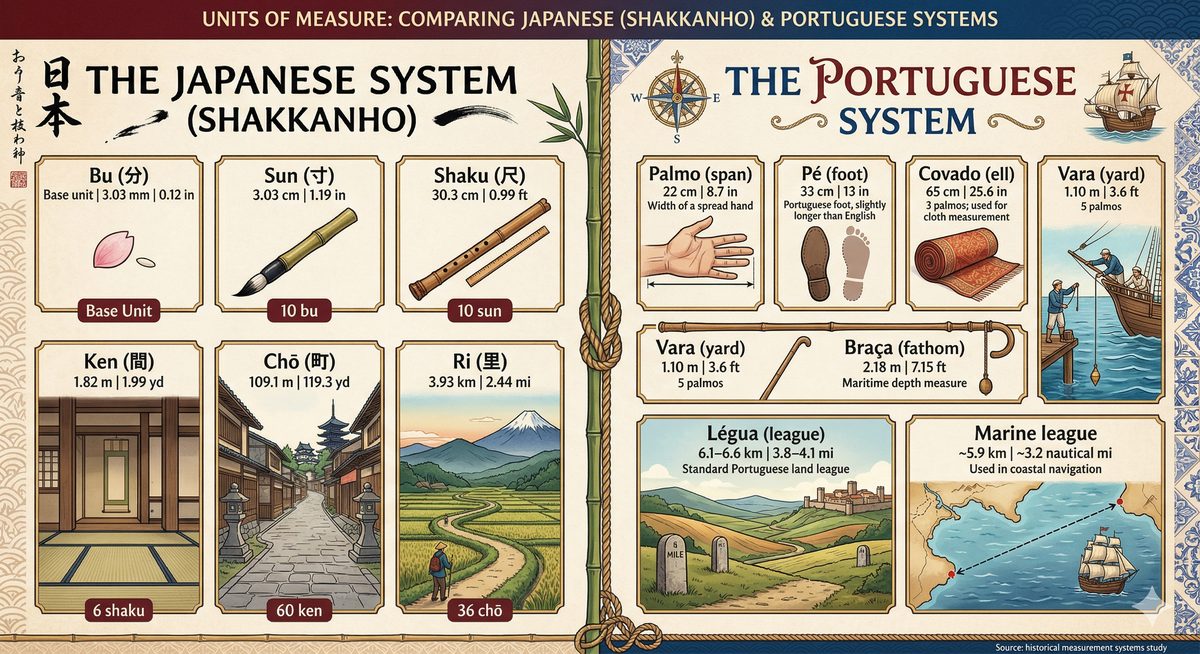
Japan's system of linear measurement descended from Chinese architectural and astronomical conventions. The base unit was the shaku, which landed at almost exactly one English foot, close enough that sailors found it eerie, different enough that surveyors found it annoying. The system scaled cleanly in both directions: downward into fine subdivisions for carpentry and metalwork, upward into geographic distances for mapping and navigation.
When the Meiji government reconciled these units against the metric system in 1891, the shaku was legally defined as exactly 10/33 of a meter.
| Unit | Composition | Metric Equivalent | Imperial Equivalent |
|---|---|---|---|
| Bu (分) | Base unit | 3.03 mm | 0.12 in |
| Sun (寸) | 10 bu | 3.03 cm | 1.19 in |
| Shaku (尺) | 10 sun | 30.3 cm | 0.99 ft |
| Ken (間) | 6 shaku | 1.82 m | 1.99 yd |
| Cho (町) | 60 ken | 109.1 m | 119.3 yd |
| Ri (里) | 36 cho | 3.93 km | 2.44 mi |
The Portuguese System
Portuguese navigators and merchants used a mix of terrestrial and maritime units, most descended from Roman and medieval Iberian conventions.
| Unit | Metric Equivalent | Imperial Equivalent | Notes |
|---|---|---|---|
| Palmo (span) | 22 cm | 8.7 in | Width of a spread hand |
| Pe (foot) | 33 cm | 13 in | Portuguese foot, slightly longer than English |
| Covado (ell) | 65 cm | 25.6 in | 3 palmos; used for cloth measurement |
| Vara (yard) | 1.10 m | 3.6 ft | 5 palmos |
| Braca (fathom) | 2.18 m | 7.15 ft | Maritime depth measure |
| Legua (league) | 6.1–6.6 km | 3.8–4.1 mi | Standard Portuguese land league |
| Marine league | ~5.9 km | ~3.2 nautical mi | Used in coastal navigation |
Volumetric Measurement and the Koku
The Foundation of the Japanese Economy
Unlike European economies that increasingly relied on minted bullion for wealth assessment, the Japanese political economy was agrarian to its core. Land was valued by what it produced. Lords were ranked by what their domains yielded. Armies were mobilized in proportion to rice output. The unit that governed all of this was the koku, defined as the volume of rice sufficient to feed one adult male for one year.
Before Toyotomi Hideyoshi's land surveys (Taiko kenchi) of the 1580s, the actual volume of the koku varied from province to province, because feudal lords manipulated the size of the wooden measuring boxes (masu), larger boxes for tax collection, smaller boxes for dispensing stipends. Hideyoshi ended the practice by mandating a single standardized box, the Kyo-masu (Kyoto measure), with fixed internal dimensions. The system then scaled cleanly:
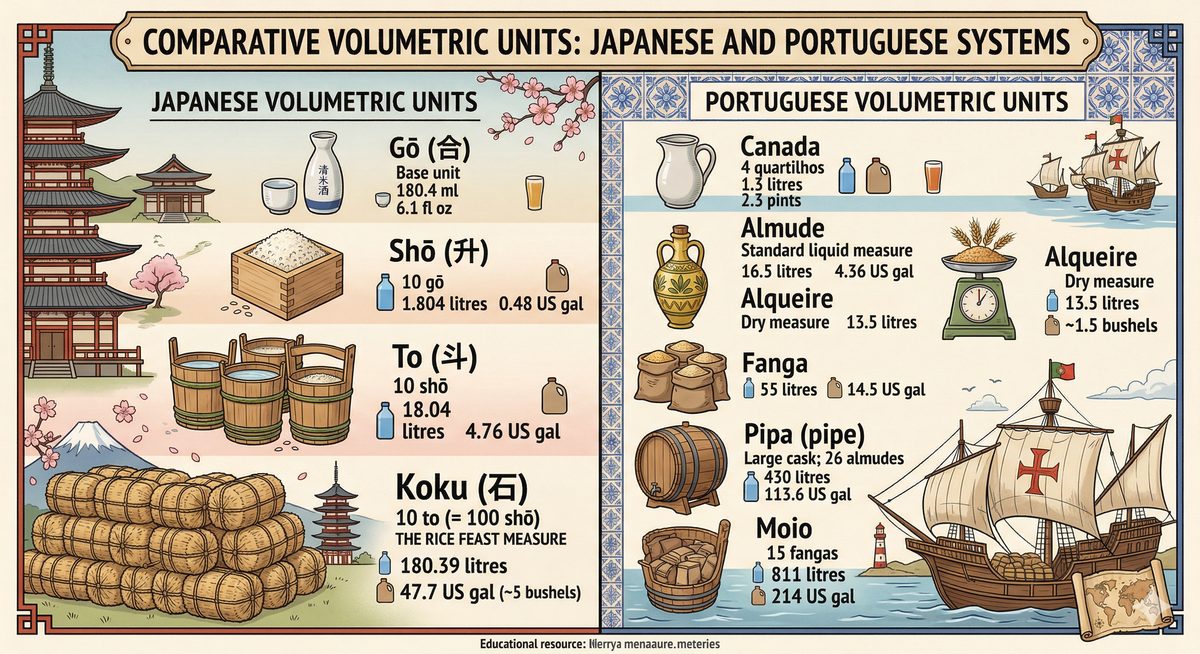
| Unit | Composition | Metric Equivalent | Imperial Equivalent |
|---|---|---|---|
| Go (合) | Base unit | 180.4 ml | 6.1 fl oz |
| Sho (升) | 10 go | 1.804 liters | 0.48 US gal |
| To (斗) | 10 sho | 18.04 liters | 4.76 US gal |
| Koku (石) | 10 to (= 100 sho) | 180.39 liters | 47.7 US gal (~5 bushels) |
Because the overwhelming commodity measured by the koku was rice, the volumetric unit carried an implicit mass equivalent: one koku of unpolished brown rice weighed approximately 150 kg (330 lb).
The Koku as Currency
The koku was not merely a measure of grain. It was the denomination of political power, military capacity, and social rank:
| Domain / Context | Kokudaka (assessed yield) | Rice equivalent |
|---|---|---|
| Minimum daimyo threshold | 10,000 koku | 1,500 metric tons/year |
| Arima domain (Christian lord) | 40,000 koku | 6,000 metric tons/year |
| Hosokawa (Kumamoto) | 540,000 koku | 81,000 metric tons/year |
| Maeda (Kaga), wealthiest domain | 1,000,000+ koku | 150,000+ metric tons/year |
The critical conversion for the Nanban trade: 1 koku of rice ≈ 1 ryo of gold (≈ 18.2 g gold) in traditional purchasing power parity. This linked the domestic agricultural economy directly to the international bullion trade.
Portuguese Volumetric Units
Portuguese merchants used their own volume measures for liquid cargoes (wine, oil) and dry goods:
| Unit | Metric Equivalent | Imperial Equivalent | Notes |
|---|---|---|---|
| Canada | 1.3 liters | 2.3 pints | 4 quartilhos |
| Almude | 16.5 liters | 4.36 US gal | Standard liquid measure |
| Alqueire | 13.5 liters | ~1.5 bushels | Dry measure |
| Fanga | 55 liters | 14.5 US gal | — |
| Pipa (pipe) | 430 liters | 113.6 US gal | Large cask; 26 almudes |
| Moio | 811 liters | 214 US gal | 15 fangas |
Ponderal (Weight) Measurement
The Asian System: Piculs, Catties, and Taels
The unit that governed the maritime trade of the South China Sea was the picul, from the Malay pikul, meaning literally “a man's shoulder-pole load.” The system was decimal at the top (100 catties to a picul) and hexadecimal at the bottom (16 taels to a catty), universally understood from Canton to Nagasaki to Malacca.
Critically, the system was not universally uniform. The catty, and therefore the picul, varied slightly between jurisdictions, and this discrepancy was a structural feature of the trade's profitability.
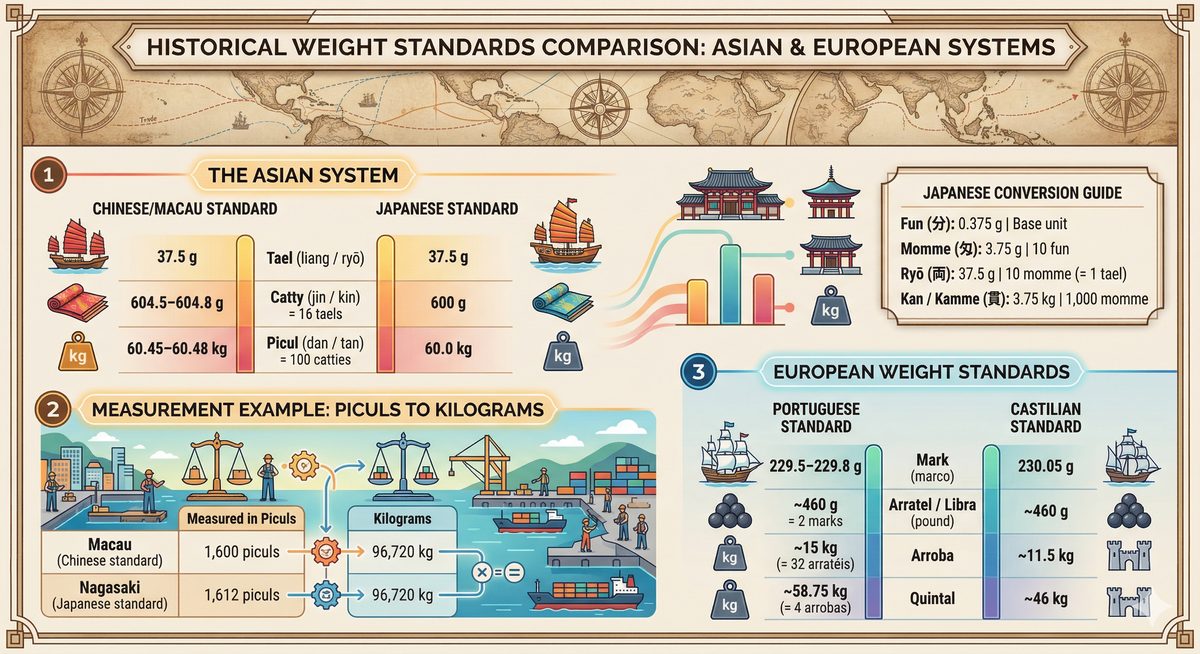
| Unit | Chinese/Macau Standard | Japanese Standard |
|---|---|---|
| Tael (liang / ryo) | 37.5 g | 37.5 g |
| Catty (jin / kin) | 604.5–604.8 g (= 16 taels) | 600 g (= 16 taels) |
| Picul (dan / tan) | 60.45–60.48 kg (= 100 catties) | 60.0 kg (= 100 catties) |
The Picul Gap in Practice
Under the armacao system that regulated the Macau–Nagasaki silk trade, Portuguese merchants were restricted to an annual export quota of 1,600 piculs of raw Chinese silk. Measured and weighed at each end of the voyage, the same physical cargo registered differently:
| Measured at | Piculs | Kilograms |
|---|---|---|
| Macau (Chinese standard) | 1,600 | 96,720 kg |
| Nagasaki (Japanese standard) | 1,612 | 96,720 kg |
The invisible yield of 12 piculs, created by nothing more than a metrological discrepancy, was worth thousands of taels of silver at Nagasaki prices.
Japanese Precious Metal Weights
For silver and gold transactions, the Japanese system used its own finely graduated scale:
| Unit | Metric Equivalent | Relationship |
|---|---|---|
| Fun (分) | 0.375 g | Base unit |
| Momme (匁) | 3.75 g | 10 fun |
| Ryo (両), as weight | 37.5 g | 10 momme (= 1 tael) |
| Kan / Kamme (貫) | 3.75 kg | 1,000 momme |
European Weight Standards
Iberian merchants carried their own ponderal system, based on the medieval Cologne mark-weight:
| Unit | Portuguese Standard | Castilian Standard |
|---|---|---|
| Mark (marco) | 229.5–229.8 g | 230.05 g |
| Arratel / Libra (pound) | ~460 g (= 2 marks) | ~460 g |
| Arroba | ~15 kg (= 32 arrateis) | ~11.5 kg |
| Quintal | ~58.75 kg (= 4 arrobas) | ~46 kg |
To convert Asian taels and catties into European marks on the docks, factors used nested brass cup-weights, precision instruments in which a large outer master-cup (weighing exactly double a Portuguese mark, ~459.6 g) contained a series of fitted inner cups for measuring fractions. Japanese bar silver was typically packed in wooden chests of exactly 1,000 taels (37.5 kg), and these nested weights allowed factors to translate the Asian mass into marks for reporting back to the Casa da India in Lisbon.
Currencies
The Problem of “Imaginary Money”
A central difficulty of Nanban-era finance is that many of the currencies appearing in historical documents did not physically exist at the time the documents were written. The Portuguese cruzado, the Venetian ducat, and the Spanish ducado all began as physical coins but evolved into abstract “units of account”, standardized values used in ledgers, contracts, and price negotiations, settled in practice by weighing out equivalent quantities of whatever bullion was actually available.
When a Portuguese ledger in Nagasaki records a debt of 1,000 cruzados, no one handed over gold coins stamped with a cross. The settlement was made by placing Japanese chogin silver on a balance scale, adjusting for the metal's purity (80% under the Keicho standard), and converting the weight into the accounting framework of reis. Understanding the currencies of the Nanban trade therefore requires tracking two things simultaneously: the nominal value (what the unit represented in the ledger) and the intrinsic value (how much metal that actually meant).
The tables below express all currencies in grams of silver equivalent, the closest thing the sixteenth-century trading world had to a common denominator.
Portuguese Currencies
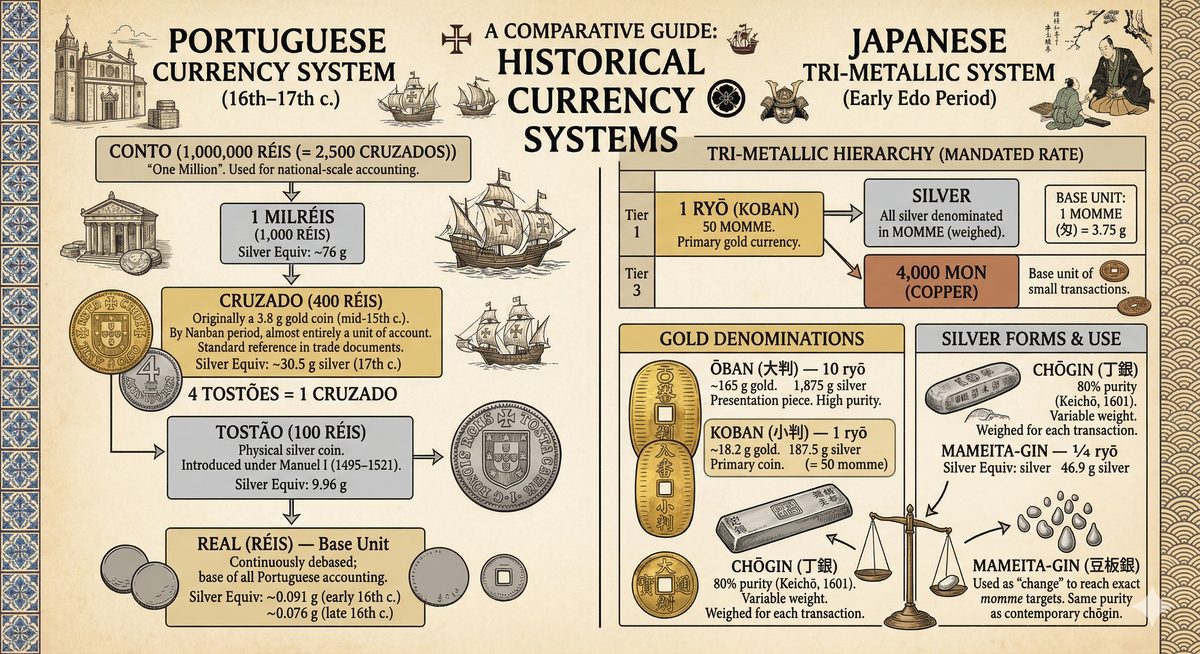
| Currency | Nominal Value | Silver Equivalent | Notes |
|---|---|---|---|
| Real (reis) | Base unit | ~0.091 g silver (early 16th c.) → ~0.076 g (late 16th c.) | Continuously debased; the base unit of all Portuguese accounting |
| Tostao | 100 reis | 9.96 g silver | Physical silver coin; introduced under Manuel I (1495–1521). Four tostoes = one cruzado |
| Cruzado | 400 reis | ~30.5 g silver (17th c.) | Originally a 3.8 g gold coin (mid-15th c.); by the Nanban period almost entirely a unit of account |
| Milreis | 1,000 reis | ~76 g silver | — |
| Conto | 1,000,000 reis (= 2,500 cruzados) | ~76 kg silver | “One million”; used for national-scale accounting |
The Debasement of the Real
The intrinsic silver content of the reis shrank steadily across the Nanban period as the Portuguese Crown stretched its mint output:
| Period | Reis struck per mark (230 g silver at 93% purity) | Silver per real |
|---|---|---|
| Early 16th century | 2,340 reis | ~0.091 g |
| Iberian Union (1580–1640) | 2,800 reis | ~0.076 g |
A long-term contract denominated in reis lost roughly 16% of its intrinsic silver value over the course of the Iberian Union, a slow, state-sponsored erosion that merchants had to factor into every multi-year deal.
Spanish Currencies
After the Iberian crowns merged under Philip II in 1580, Spanish coinage flooded the Asian maritime networks, primarily via the Manila galleon trade.
| Currency | Nominal Value | Silver Equivalent | Notes |
|---|---|---|---|
| Maravedi | Base unit | ~0.094 g silver | Spanish base accounting unit |
| Real (Spanish) | 34 maravedis | ~3.19 g silver | Not to be confused with the Portuguese real |
| Peso de ocho (piece of eight) | 8 reales (= 272 maravedis) | ~25.5 g silver | The closest thing to a global reserve currency in the 16th–17th centuries |
Key equivalence: 1 peso de ocho ≈ 400 Portuguese reis ≈ 1 cruzado (in accounting terms). European factors in Japan used the shorthand: 4 taels of Japanese silver ≈ 5 pesos de ocho.
Gold Coins and Units of Account
| Currency | Metal Content | Silver Parity | Notes |
|---|---|---|---|
| Cruzado (original gold coin) | ~3.8 g gold (23¾ carat) | — | Minted mid-15th c. to finance North African crusades; largely vanished from circulation by mid-16th c. |
| Ducat (Venetian/Spanish) | ~3.5 g gold (98.6% purity) | ~35.3 g silver | Functioned as both physical coin and unit of account |
| Crown (coroa / ecu) | Variable; ~2.8–3.5 g gold | Variable | General term for heavy gold or silver coins in state transactions |
Other Currencies Encountered in the Trade Network
The Nanban trade touched every major currency zone between Lisbon and Nagasaki. Merchants encountered:
| Currency | Origin | Value / Equivalence |
|---|---|---|
| Xerafim | Portuguese India (Goa) | 300 reis; 5 tangas. 12 xerafins ≈ 1 cruzado (Goa, 1637) |
| Pardau | Portuguese India | 300–360 reis (silver or gold variants) |
| Pagoda | South India | ~360 reis; gold coin |
| Fanam | South India | 20–40 reis; tiny gold coin |
| Larin | Persia / Indian Ocean | ~60 reis; silver wire bent double |
| Florin / Guilder | Dutch | 20 stuivers; “100,000 guilders = 1 ton of gold” was a Dutch accounting convention |
| Cash (caixa) | China / Japan | Copper coin with square hole; 1,000 cash ≈ 1 cruzado (fluctuating). Strung on cords in batches of 100 or 1,000 |
The Japanese Tri-Metallic System
Overview
The monetary system formalized under Tokugawa Ieyasu from 1601 was a deliberate, state-controlled tri-metallic regime using gold, silver, and copper. Each metal circulated in its own physical form with its own dominant geography: gold predominated in eastern Japan (Edo), silver in western Japan and the international ports (Osaka, Nagasaki), and copper served as everyday small-denomination currency everywhere.
Official exchange rates mandated by the Tokugawa Shogunate:
| Gold | Silver | Copper |
|---|---|---|
| 1 ryo (koban) | 50 momme (187.5 g silver) | 4,000 mon |
Market rates frequently deviated from these mandated ratios, but merchants who valued their trading licenses observed the official fiction.
Gold
| Denomination | Weight | Purity | Silver Equivalent (mandated rate) |
|---|---|---|---|
| Koban (小判), 1 ryo | ~18.2 g gold | Variable by era; high initially | 187.5 g silver (= 50 momme) |
| Oban (大判), 10 ryo | ~165 g gold | Presentation piece; high purity | 1,875 g silver |
| Ichibuban, ¼ ryo | ~4.5 g gold | Variable | 46.9 g silver |
Silver
Silver in Japan was a currency by weight, not by denomination. Every transaction required a balance scale.
| Form | Description | Purity | Notes |
|---|---|---|---|
| Chogin (丁銀) | Elongated bar, stamped with era name and ginza mint mark | 80% (Keicho, 1601) | Variable weight; must be weighed for each transaction |
| Mameita-gin (豆板銀) | Small pill- or bean-shaped silver droplets | Same as contemporary chogin | Used as “change” to reach exact momme targets on the scale |
The base unit: 1 momme (匁) = 3.75 g. All silver transactions were denominated in momme.
The Debasement Crisis
The massive outflow of silver through the Nanban trade (and subsequently through the Dutch and Chinese trades) steadily drained Japan's treasury. The shogunate's response was serial debasement:
| Era | Issue Date | Silver Purity | Pure Silver per Momme |
|---|---|---|---|
| Keicho (慶長) | 1601 | 80% | 3.00 g |
| Genroku (元禄) | 1695 | 64% | 2.40 g |
| Hoei (宝永) early | 1706 | 50% | 1.875 g |
| Hoei Yotsu-ho (宝永四ツ宝) | 1711 | 20% | 0.75 g |
A momme of Keicho silver contained four times the actual silver of a Hoei Yotsu-ho momme. Trade documents from 1610 and trade documents from 1710 that both quote prices in “momme of silver” are, in metallurgical reality, referring to entirely different substances. Any historical exchange rate must be indexed to the specific coinage era to have meaning.
Bimetallic Arbitrage: The Engine of the Trade
The Global Silver-Gold Ratio
The entire financial architecture of the Nanban trade was built on the fact that the three major economies of the sixteenth-century world assigned wildly different values to gold relative to silver. The Portuguese did not merely trade goods. They traded the price of metal itself, carrying silver from places where it was common to places where it was scarce, and gold in the opposite direction.
| Region | Gold-to-Silver Ratio (c. 1580–1620) | Meaning |
|---|---|---|
| Europe | 1:11 to 1:12 | 12 oz silver buys 1 oz gold |
| Japan | 1:10 | 10 oz silver buys 1 oz gold |
| Mughal India | 1:8 | 8 oz silver buys 1 oz gold |
| Safavid Persia | 1:10 | 10 oz silver buys 1 oz gold |
| Ming China | 1:5.5 to 1:7 | 6 oz silver buys 1 oz gold |
China's ratio was the global anomaly. The Ming Dynasty had catastrophically overprinted paper currency in the fifteenth century, triggering hyperinflation so severe that the entire economy abandoned paper money and converted to a silver bullion standard (formalized in the Single Whip Tax Reform). The resulting demand for silver was effectively infinite. Meanwhile, China had abundant domestic gold. The result: silver was worth almost twice as much in China as in Europe.
The Arbitrage Loop
The Portuguese exploited this disparity through a circular trade route:
- Macau: Buy Chinese raw silk with silver (or European/Indian goods). Silk purchased at ~80 taels per picul.
- Nagasaki: Sell silk to Japanese buyers at 140–150 taels per picul (sometimes higher). Receive payment in Japanese silver, valued locally at 1:10 against gold.
- Return to Macau: Ship Japanese silver to China, where it is valued at 1:6 against gold, an immediate ~40–60% appreciation in purchasing power.
- Buy Chinese gold with the appreciated silver. Ship gold back to Japan and to India or Europe, where the ratio is 1:12, effectively doubling the initial capital.
No manufacturing involved. Value added solely through geographic displacement of metal.
Quantified Returns
| Year | Arbitrage Margin (gold/silver, China–Japan) | Notes |
|---|---|---|
| c. 1580–1620 | ~60% | Peak profitability |
| c. 1630s | ~30% | Japanese domestic gold production increasing |
| Flow | Estimated Volume |
|---|---|
| Japanese silver exported annually (peak) | 50–150 metric tons |
| Total annual trade value (Macau–Nagasaki) | Up to 4,000,000 cruzados (~122 metric tons of silver equivalent) |
| Captain-Major's personal profit per voyage | 150,000–200,000 cruzados (~4.6–6.1 metric tons of silver equivalent) |
Commodity Prices
Silk, The Supreme Cargo
Raw Chinese silk was the commodity that justified the entire Macau–Nagasaki trade route. The price differential between the Chinese source market and the Japanese destination market was extraordinary.
| Commodity | Buy Price (Canton/Macau) | Sell Price (Nagasaki) | Margin |
|---|---|---|---|
| Raw white silk (per picul) | 80 taels (3,000 g silver) | 140–150 taels (5,250–5,625 g silver) | 75–88% |
| Colored silk (per picul) | 40–140 taels (1,500–5,250 g silver) | 100–400 taels (3,750–15,000 g silver) | Variable, often >100% |
| Silk at peak scarcity (per picul) | — | Up to 1,500 taels (56,250 g silver) | — |
The Great Ship typically carried 500–600 piculs of raw silk, 400–500 piculs of colored silk thread, and up to 1,600 piculs total under the armacao quota.
Other Major Commodities
| Commodity | Price (per picul unless noted) | Silver Equivalent | Market |
|---|---|---|---|
| Refined copper | 12&frac19; taels | 454 g silver | Japan (export) |
| Quicksilver | 53 taels (buy) → 90 taels (sell) | 1,988 g → 3,375 g silver | Canton → Nagasaki |
| Pepper | 9–10 Spanish dollars | 229–255 g silver | — |
| Lead | 60–88 reales | 191–281 g silver | — |
| Camphor | 10 taels | 375 g silver | — |
| Cinnabar | 40 taels | 1,500 g silver | — |
Luxury and Prestige Goods
These prices appear in Jesuit and European observer accounts, typically denominated in ducats (~3.5 g gold each) or cruzados (~30.5 g silver each):
| Item | Price | Silver / Gold Equivalent |
|---|---|---|
| Tea kettle (prized) | 600 ducats | 2,100 g gold |
| Tripod (ceremonial) | 1,030 ducats | 3,605 g gold |
| Earthenware tea caddy (top tier) | 14,000–30,000 ducats | 49–105 kg gold |
| Arabian horse | 500–600 cruzados | 15.3–18.3 kg silver |
| Coat of mail (siege inflation, Ternate 1536) | 100–150 cruzados | 3.1–4.6 kg silver |
| Pig (siege inflation, Ternate 1536) | 50 cruzados | 1.5 kg silver |
| She-goat (siege inflation, Ternate 1536) | 15–16 cruzados | 458–488 g silver |
Master Conversion Table
Currency to Grams of Silver
For quick cross-reference, all major currencies expressed in grams of silver (using the most common Nanban-period standard, c. 1580–1620):
| Currency | Nominal Value | Grams of Silver |
|---|---|---|
| 1 Portuguese real | — | ~0.091 g |
| 1 tostao | 100 reis | 9.96 g |
| 1 cruzado | 400 reis | ~30.5 g |
| 1 Spanish real | 34 maravedis | ~3.19 g |
| 1 peso de ocho | 272 maravedis (= 8 reales) | ~25.5 g |
| 1 ducat (silver parity) | 375 maravedis | ~35.3 g |
| 1 Japanese momme | — | 3.75 g (gross); 3.00 g pure at Keicho 80% |
| 1 Japanese ryo (gold koban) | 50 momme (mandated) | 187.5 g silver equivalent |
| 1 Chinese/Japanese tael | — | 37.5 g |
| 1 copper mon | — | ~0.0469 g silver (at mandated rate) |
Quick Equivalences Used on the Docks
These are the rough-and-ready conversions that merchants actually used, not precise mathematical equalities but practical accounting shortcuts:
| Equivalence | Basis |
|---|---|
| 1 tael ≈ 1 cruzado | Joao Rodrigues's commercial shorthand (37.5 g vs. 30.5 g, ~23% discrepancy accepted for speed) |
| 4 taels ≈ 5 pesos de ocho | European factors' standard conversion |
| 1 koku of rice ≈ 1 ryo of gold | Traditional Japanese purchasing power parity |
| 1 cruzado ≈ 400 maravedis ≈ 1 peso de ocho | Iberian accounting convention |
| 3 cruzados ≈ 2 taels | Documented Luso-Chinese exchange rate |
| 1 cruzado ≈ 600–1,000 cash | Copper-to-silver rate varied with supply |
Weight to Metric
| Unit | Grams | Kilograms |
|---|---|---|
| 1 momme | 3.75 g | — |
| 1 tael | 37.5 g | — |
| 1 catty (Chinese) | 604.5 g | 0.605 kg |
| 1 catty (Japanese) | 600.0 g | 0.600 kg |
| 1 Portuguese mark | 229.5–229.8 g | — |
| 1 arratel / libra | ~460 g | 0.460 kg |
| 1 picul (Chinese) | — | 60.45 kg |
| 1 picul (Japanese) | — | 60.00 kg |
| 1 arroba (Portuguese) | — | ~15 kg |
| 1 quintal (Portuguese) | — | ~58.75 kg |
| 1 kan (1,000 momme) | — | 3.75 kg |
Approximate Modern Equivalents
Converting sixteenth-century currencies to modern values is inherently imprecise. Two methods exist: bullion value (what the metal content is worth at today's spot prices) and purchasing power parity (what the money could buy, translated to modern goods). Both are offered below as rough guides, using gold at approximately US$3,050 per troy ounce and silver at approximately US$34 per troy ounce (March 2026 spot prices).
| Currency | Metal Content | Bullion Value (2026) | Purchasing Power Estimate |
|---|---|---|---|
| 1 cruzado | ~30.5 g silver | ~US$33 | ~US$100–400 |
| 1 ducat | ~3.5 g gold (98.6% fine) | ~US$345 | ~US$100–400 |
| 1 tostao | 9.96 g silver | ~US$11 | ~US$25–100 |
| 1 tael | 37.5 g silver | ~US$41 | ~US$50–250 |
| 1 koku | ~150 kg rice | ~US$150–300 (rice value) | ~US$2,000 (≈¥300,000) |
| 1 ryo (koban) | 18.2 g gold | ~US$1,785 | Variable |
In the 1600s, a silver cruzado contained roughly the equivalent of a few days to a full week's wages for a skilled laborer or artisan. If we compare that to what a general laborer makes in a week today, a single cruzado held about $600 to $1,000 in modern purchasing power.
Outfitting a massive, 1,000-ton merchant ship (a carrack) to sail to India would cost the Portuguese crown around 50,000 cruzados.
Illustrative Scale
| Amount | Bullion Value (2026) | Context |
|---|---|---|
| Captain-Major's profit: 150,000–200,000 cruzados | ~US$5–6.6 million | Single voyage, 18 months |
| Annual Macau–Nagasaki trade: ~4,000,000 cruzados | ~US$132 million | Total annual commerce |
| Jesuit annual silk profit: 4,000–6,000 ducats | ~US$1.4–2.1 million | Funded the entire Japan mission |
| Daimyo of Kaga: 1,000,000+ koku | ~US$2 billion+ (purchasing power) | Wealthiest domain in Japan |
| Japanese annual silver export (peak): 150 tons | ~US$164 million | Dwarfed European imports to Asia |
These comparisons necessarily compress the vast differences in price structures, labor costs, and availability of goods between the sixteenth century and the present. They should be treated as orders of magnitude, not precise equivalences.
Sources & Further Reading
Boyajian, James C. Portuguese Trade in Asia under the Habsburgs, 1580–1640. Johns Hopkins University Press, 2008. The definitive English-language study of the commercial mechanics of the Estado da Índia, with detailed analysis of currency conversions and trade volumes.
Boxer, C.R. The Great Ship from Amacon: Annals of Macao and the Old Japan Trade, 1555–1640. Centro de Estudos Históricos Ultramarinos, 1959. Meticulous reconstruction of the Macau–Nagasaki trade, with extensive data on commodity prices, exchange rates, and the armação system.
Flynn, Dennis O. and Arturo Giráldez. “Metals and Monies in an Emerging Global Economy.” In Handbook of the History of Money and Currency, edited by Stefano Battilossi et al. Springer, 2020. Essential overview of the global silver cycle and the bimetallic arbitrage that drove early modern transoceanic trade.
Kobata Atsushi. “The Production and Uses of Gold and Silver in Sixteenth- and Seventeenth-Century Japan.” Economic History Review 18, no. 2 (1965): 245–266. Foundational quantitative study of Japanese precious metal output, including mint specifications and purity standards.
Souza, George Bryan. The Survival of Empire: Portuguese Trade and Society in China and the South China Sea, 1630–1754. Cambridge University Press, 1986. Essential for the metrological practices of the Macau trading community, including picul standards and regional variations.
Shimada Ryūto. The Intra-Asian Trade in Japanese Copper by the Dutch East India Company during the Eighteenth Century. Brill, 2006. Detailed exposition of the catty, picul, and tael weight standards in practice.
Tashiro Kazui. “Exports of Japan's Silver to China via Korea and Changes in the Tokugawa Monetary System.” In Precious Metals in the Later Medieval and Early Modern Worlds, edited by J.F. Richards. Carolina Academic Press, 1983. Critical for understanding the post-Nanban debasement of the chogin.
Bank of Japan, Institute for Monetary and Economic Studies. Currency Museum: Historical Events and Currencies in Use. Online collection with detailed numismatic data on Keichō, Genroku, and Hōei-era coinage specifications.
De Sousa, Lúcio. The Portuguese Slave Trade in Early Modern Japan. Brill, 2019. Valuable archival data on monetary instruments and conversion rates in Nanban-era transactions.
Oka Mihoko. “Great Merchants and the Nanban Trade.” In Nanban: The Encounter between Japan and Europe, 1543–1614. Museu Nacional de Arte Antiga, 2021. Overview of commercial actors and metrological instruments of the Nanban trading houses.